.png?width=2338&height=1250&name=gold-2color-horizontal%20copy%20(3).png "X Agency Digital Marketing Agency Logo")
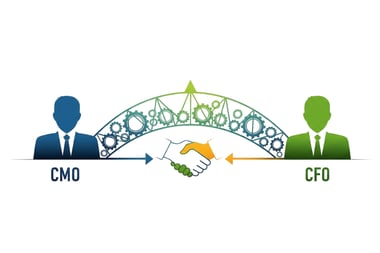
Marketers often measure success in terms of clicks, leads, or ROAS. CFOs, on the other hand, care about profitability, margins, and sustainable cash flow. This disconnect explains why so many marketing teams struggle to justify their budgets when it matters most: in the boardroom.
If marketing leaders can’t connect campaign results to financial outcomes, budgets get cut and credibility suffers. But when CMOs speak in CFO language — translating activity into revenue, margin, and net income — marketing shifts from being seen as a cost center to a growth engine.
Why the Gap Exists
The CMO’s world revolves around engagement, acquisition, and brand growth. The CFO’s world is about EBITDA, operating margins, and return on capital. Both are valid, but they operate on different timelines and vocabularies.
Marketing campaigns may generate quick wins in lead volume or ROAS, while financial leaders need to see quarterly or annual contributions to profitability. Without a bridge between these perspectives, marketing’s impact can feel intangible to executives who sign off on budgets.
What CFOs and Boards Care About
CFOs aren’t looking for click-through rates. They want to know:- Did this initiative grow top-line revenue?
- Did it help improve gross margins by strengthening pricing power or reducing costs?
- Did it expand operating margins by making acquisition more efficient?
- How did it affect net income and ultimately cash flow?
- Does it improve long-term enterprise value?
Answer those questions, and marketing earns a seat at the strategic table.
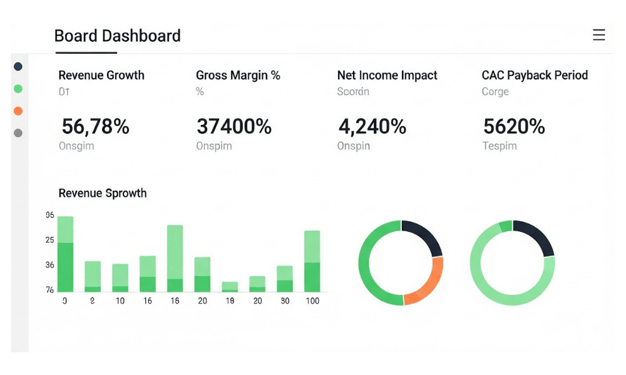
Translating Marketing Metrics into Financial Terms
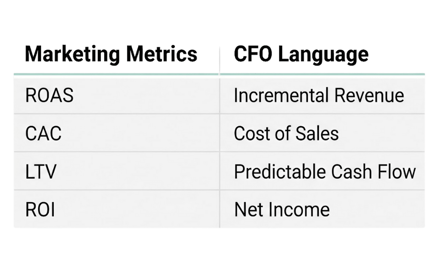
The key is reframing common marketing metrics:
- ROAS → Incremental Revenue. Instead of "ROAS of 2.7," say "Every $1 in marketing generated $2.70 in revenue."
- CAC → Cost of Sales. Position customer acquisition cost as part of the company’s unit economics.
- LTV → Predictable Cash Flow. Customer lifetime value demonstrates the sustainability of future revenue streams.
- ROI → Net Income Contribution. Show not just revenue lift, but how campaigns increased profits after costs.
With this translation, marketing metrics stop being "vanity" numbers and start looking like financial performance indicators.
A Practical Framework for Translation
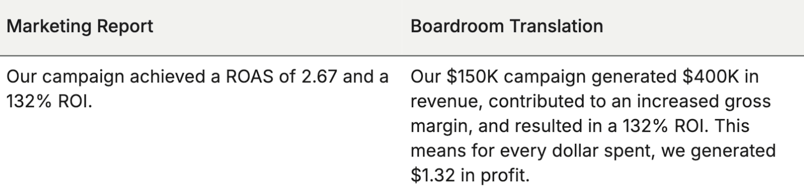
Here’s an example of how a campaign story might change with the right framing:
Benefits of Bridging the Gap
When CMOs consistently translate into financial outcomes, three things happen:
-
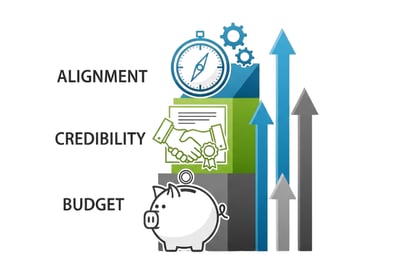
- Budgets get protected (and even expanded). CFOs see marketing as an investment with measurable returns.
- Credibility increases. Marketing is no longer viewed as discretionary, but as critical to enterprise growth.
- Alignment improves. CMO and CFO strategies converge on profitability and shareholder value.
Conclusion: Speaking CFO Is a Competitive Advantage
The best marketing leaders don’t just talk about clicks and conversions. They tell the story of how marketing grows revenue, strengthens margins, and increases profitability.
When campaign results are translated into the language of finance, marketing isn’t just part of the conversation — it leads it.
If you want your marketing to resonate in the boardroom, start by reframing your results in terms your CFO and investors care about. And if you’d like a partner who can help translate campaigns into financial outcomes, let’s talk.