.png?width=2338&height=1250&name=gold-2color-horizontal%20copy%20(3).png "X Agency Digital Marketing Agency Logo")
In most organizations, marketing budgets are set annually or quarterly, often as a percentage of revenue or industry benchmark. But treating marketing spend as a fixed budget misses the bigger picture.
At its core, marketing is a capital allocation decision. Just like a CFO decides whether to invest in new equipment, expand headcount, or acquire another business, every additional dollar of marketing spend should be evaluated on its ability to create real enterprise value.
The CFO’s Lens: Marginal ROI
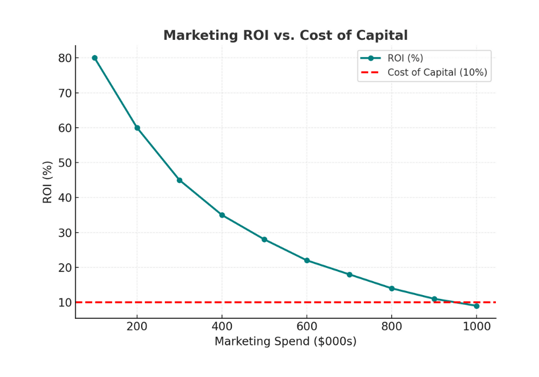
Finance leaders don’t just look at totals; they look at marginal returns — the impact of spending the next dollar.- If the marginal return on marketing is higher than the firm’s cost of capital, it’s value-accretive.
- If it’s lower, then every incremental dollar erodes shareholder value.
That’s why the key question is not “What is our ROAS?” but “What is the ROI on the next dollar we spend?”
Contribution to Enterprise Value
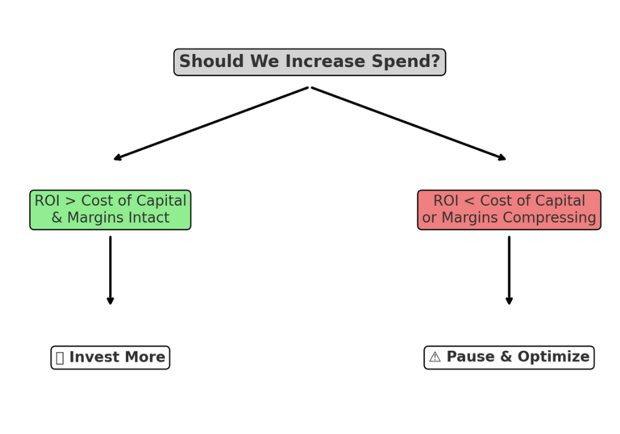
For marketing spend to create real value, it must:-
- Generate Incremental Cash Flow. Campaigns should deliver returns above their cost.
- Scale Profitably. Margins must remain healthy as spend increases.
- Improve Long-Term Value. Gains should strengthen retention, brand equity, or customer lifetime value (LTV).
When these conditions hold, increasing marketing spend isn’t just “buying growth” — it’s making a capital allocation decision that enhances enterprise value.
A Practical Example
- Marketing spend: $500K
- Incremental revenue: $1.2M
- Gross margin: 55% → $660K gross profit
- Net incremental profit after marketing: $160K
- ROI: 32%
- Weighted Average Cost of Capital (WACC): 10%
Result: ROI is well above WACC, so each incremental dollar is creating value.
Now suppose spend increases to $800K and ROI falls to 12% — still above the cost of capital, but much closer to the threshold. Beyond that point, additional spend may destroy value rather than create it.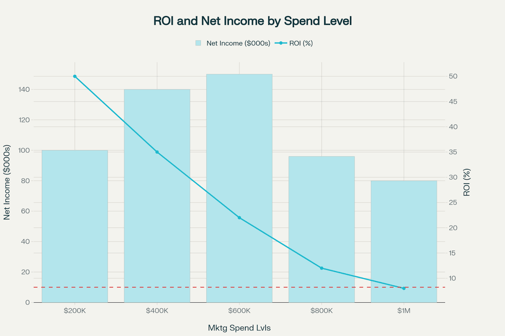
Thinking Like a CFO
Marketers who adopt a capital allocation mindset:
- Earn credibility in boardroom discussions.
- Secure budgets by tying spend directly to shareholder value.
- Avoid the trap of chasing growth at the expense of profitability.
The language of finance is clear: every marketing dollar is an investment. The only question is whether it’s earning more than it costs.
Conclusion: From Budget to Investment
Marketing shouldn’t be seen as a discretionary budget item. It should be managed as an investment portfolio, with spend increasing only when the marginal return justifies it.
By reframing marketing as a capital allocation decision, companies ensure that growth isn’t just fast — it’s profitable, sustainable, and value-creating.
X Agency empowers marketers to adopt this CFO-level thinking, providing the insights and analytics needed to connect every marketing dollar to tangible financial outcomes and optimize capital allocation for maximum enterprise value.