.png?width=2338&height=1250&name=gold-2color-horizontal%20copy%20(3).png "X Agency Digital Marketing Agency Logo")
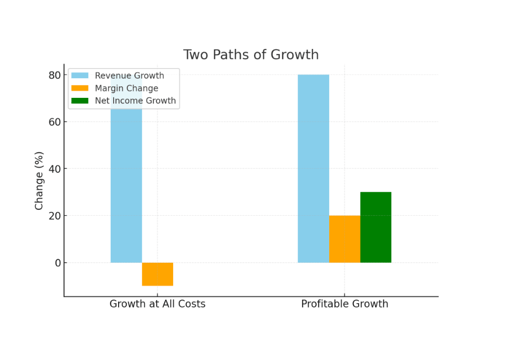
In digital marketing, growth is often the headline goal. More leads, more customers, more revenue. But there’s a hidden truth that many brands discover the hard way: growth at all costs can erode profitability.
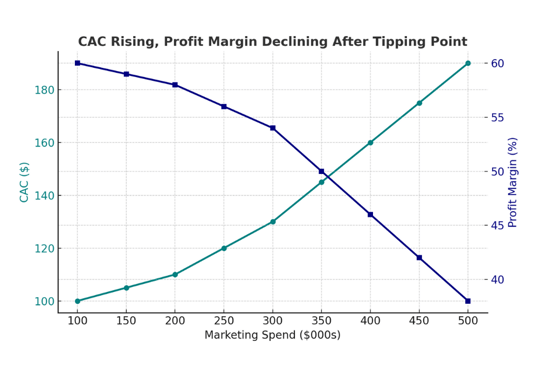
The reality is that scaling campaigns often increases customer acquisition cost (CAC). If CAC grows faster than customer lifetime value (LTV), margins shrink — and in some cases, net income can decline even as revenue rises. The challenge isn’t growth for its own sake; it’s sustainable, profitable growth.
The Growth–Profitability Trade-Off
Early in a brand’s growth journey, digital campaigns usually deliver strong returns. The audience is highly responsive, CAC is low, and every dollar spent on marketing produces multiples in revenue.
But as spend scales:
- CAC increases. You exhaust the most efficient channels and audiences, forcing you to spend more to acquire the next customer.
- Margins compress. Higher acquisition costs eat into contribution margin.
- Net income suffers. Revenue rises, but profit per customer shrinks, leaving less to reinvest in the business.
Why CAC Efficiency Matters More Than Top-Line Growth
Revenue alone doesn’t build enterprise value. Investors and boards look at profitability and efficiency of growth. That’s why metrics like:
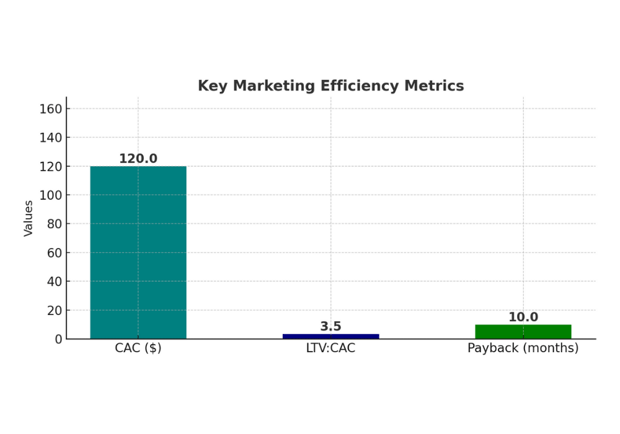
- LTV:CAC Ratio (are we creating long-term value for every dollar spent?)
- CAC Payback Period (how quickly do we recover acquisition costs?)
- Contribution Margin per Customer (does each new customer add or subtract from net income?)
are far more important than topline growth rates.
Finding the Balance: When to Push and When to Hold Back
Scaling profitably means knowing when to keep investing and when to pause:
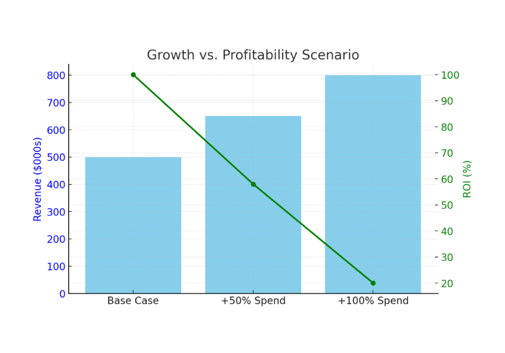
- Push harder when: CAC is stable, payback is within target (e.g., <12 months), and marginal ROI is higher than your cost of capital.
- Hold back when: CAC is rising sharply, margins are compressing, or incremental customers are less profitable than the existing base.
Think like a CFO: every marketing dollar is a capital allocation decision. If the return is above threshold, invest more. If not, optimize before scaling further.
How to Protect Profitability While Growing
- Segment and Prioritize Audiences. Scale into the most profitable customer segments first before chasing volume.
- Invest in Retention. It’s cheaper to grow LTV than to endlessly lower CAC.
- Optimize Creative and Channels. Test constantly to push CAC back down as you scale.
- Model Scenarios. Run "what if" analyses: if we increase spend by X%, what happens to CAC, margin, and net income?
- Set Guardrails. Define profitability thresholds (e.g., never let payback exceed 18 months).
Conclusion: Growth That Builds Value
Chasing growth without regard to profitability is like filling a leaky bucket — you might pour in revenue, but little makes it to the bottom line. Sustainable growth comes from balancing acquisition scale with efficiency, protecting margins while building enterprise value.
The brands that win aren’t the ones that simply grow the fastest — they’re the ones that grow profitably.
If you want to ensure your growth strategy fuels profitability (not just revenue), let’s talk about building CAC efficiency and financial guardrails into your marketing plans.